Drip, Micro-Sprinklers or Impact Sprinklers for an Orchard Block
There's no single best emitter, but there are good questions to ask before you buy a mile of tubing.
October 7, 2026 · 4 min read
Ask ten growers in the upper valley which emitter is best and you'll get several honest answers. Each one is right for the block they have. Soil, slope, water quality, tree age and how much time you have to maintain the system all push the answer in different directions. Instead of picking a winner, it helps to understand what each type does well, where it struggles, and what it asks of you in return.
What drip does well
Drip puts water at the tree, a little at a time, with very little lost to wind or evaporation. Because it wets a narrow strip, the ground between rows stays dry, which keeps equipment moving and weeds down in the alleys. Flow from each emitter is small, so a drip block can often run on a smaller pump and smaller pipe than a block of full-size sprinklers.
The trade-off is attention. Emitters are small, and small openings plug. Drip depends on good filtration, a regular flush routine, and a habit of walking the rows. Rodents chew tubing, mowers and cultivators catch lines, and a plugged emitter is easy to miss because the tree just slowly looks tired. If you like to check your blocks regularly, drip rewards it. If your time is stretched thin, think hard before committing.
Where micro-sprinklers fit
A micro-sprinkler sits between drip and a full-size sprinkler. It throws water in a small circle or fan around the tree, so the wetted area is wider than a drip point. That's a real help in light, fast-draining soil, where water from a single drip point may move straight down instead of spreading out. It also gives young roots more ground to explore.
Micro-sprinklers are less prone to plugging than drip emitters, because their openings are larger, but they still need clean water. They also lose more to wind and evaporation than drip does, and a bug nest or a spider web in the orifice can stop one dead. Their wetted pattern puts water on the ground near the trunk, which some growers like and others work around by changing the nozzle or the spacing.
What impact and rotating sprinklers bring
Overhead sprinklers cover the most ground per head. They move a lot of water, they work with larger pipe, and they're hard to plug up completely. Some growers use overhead systems for more than watering, such as cooling the block on a hot afternoon. That's a design question, and it's one to work through with someone who has seen your site before you buy anything.
The cost of coverage is that overhead water is the most affected by wind and evaporation, and it wets the leaves, fruit and ground between the rows all at once. Wet foliage invites disease pressure in some crops and some years. Overhead systems also run at higher pressure and need a pump and pipe sized for the flow.
Questions to answer before you choose
Rather than start with the hardware, start with your own block. These questions do most of the sorting:
- How fast does your soil drain? Sandy ground and heavy ground want different wetting patterns.
- How clean is your water source, and what does your filter station really handle?
- How steep is the block? Slope changes pressure from the top of a line to the bottom.
- How old are the trees? Young trees and mature trees use water and root space differently.
- How often will someone walk the rows and check emitters?
- What do you already own? Reusing a good mainline and pump can change the math.
- Are you replacing a system that failed, or building a new block from scratch?
Mixing methods is normal
Plenty of ranches run more than one type. A new planting might start on drip, then add micro-sprinklers as the roots spread. A slope might use drip where pressure is hard to hold, and overhead sprinklers on the flat. There's nothing wrong with that, as long as each valve section serves one type. Mixing emitters with very different flow rates on the same lateral is how you end up with wet and dry spots in the same row.
Pressure and flow have to be matched across a section. If one end of a line gets plenty and the other end barely drips, the emitter isn't the problem. The pipe size, the length of run, or the elevation change is. That's the kind of thing worth sketching out on paper before you order.
Get the layout right first
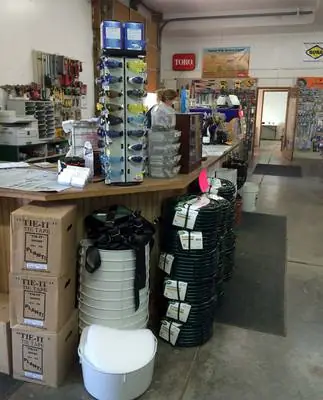
The hardware is the easy part. Hydraulics decide whether it works: how big the pipe is, how long the run is, how much pressure you lose along the way, and how many sections the pump can carry at once. Orchard design is one of the services Foothills Irrigation lists, so if you're planning a new block or rebuilding an old one, it's worth talking it through at the counter before you commit to a pile of parts.
The store carries Nelson, Toro, Antelco and Irritec irrigation products, along with PVC pipe, valves and the filtration pieces that go with them. Looking at the actual emitters, side by side, often settles an argument faster than a catalog does. Bring your questions about soil and slope, and bring a rough map of the block if you have one.
Whichever type you land on, plan for the maintenance that goes with it. A drip block you flush and walk will outperform a better system nobody checks. The best choice is the one you'll keep up.
Foothills Irrigation, (509) 678-4951
Call (509) 678-4951More articles
Spring Start-Up Checklist for Your Orchard Irrigation System
Do the start-up in the same order every year and small problems stay small.
Picking Season Prep: Bags, Tickets, Ladders and Trellis Checks
Most picking-day problems can be seen in the week before the crew arrives.